Wednesday, September 26, 2012

Colorado Oldie Pattern

The  Buckskin Nymph
The following comments excerpted from the from the books;

Popular Fly Patterns, Page 77 by Terry Hellekson, Publish Date 1977.
This pattern was sent to me by George Bodmer of Colorado Springs, Colorado. As you can see, George and his friends like their nymphs simple. They usually fish them weighted and deep. They do not like a pattern so complicated to tie that they get emotionally involved when they lose one.
Fish Flies, The Encyclopedia of the Fly Tier’s Art, Page 194, by Terry Hellekson, Publish Date 2005.
George Bodmer of Colorado Springs, Colorado originated this pattern. As you can see, George keeps some of his patterns very simple. Natural chamois is a yellowish beige color and darkens well after it becomes wet.
The following flies were tied by me using a car washing "Natural Chamois" (I think it is Kid Goat skin and not the REAL French Chamois)


Buckskin Nymph (Dry)

Buckskin Nymph (Wet)

Saturday, September 15, 2012

Another Hopper Blog

While snooping around the internet I stumbled across a Hopper exclusive blog.
The blog name is Hopper Fishing hopper talk blog. Tthe URL; is http://hopperfishing.wordpress.com/
Check it out

Thursday, September 13, 2012

Streamer Pattern!

This time of the year is Streamer Time!
I first tied and tested this pattern on the North Platte (Trappers Route Area) in 1977 when I was working in Casper Wyo. Just in case you are wondering it still worked in 2010. I normally fish this pattern with a floating line and without any weight incorporated into the fly. If I want to fish it deeper I add split shot 12” to 18” in front of the fly.


Trappers Route Muddler #1
By: Larry O Jurgens
Hook: TMC 5262 or TMC 5263 Originally Tied On Mustad 9671 or Mustad 9672
Size: 2 ~ 12
Thread: Size A White Monocord
Tail: Red Hackle Fibers or Bucktail or Fis-Hair
Body: Silver Tinsel Chenille
Wing: Yellow Marabou
Wing Topping: Peacock Herls
Head & Collar: Bleached Deer Hair


Tuesday, August 14, 2012

Fisherman Quote

We ask a simple question

And that is all we wish:


Are fishermen all liars?


Or do only liars fish?


~ William Sherwood Fox


Quotation from the book “HOOKED Funny Quotes from Serious Anglers” Edited by Raye Carrington

Sunday, August 05, 2012

Fisherman Quote


There he stands, draped in more equipment than a telephone lineman, trying to outwit an organism with a brain no bigger than a breadcrumb, and getting licked in the process.
          ~ Paul O’Neill

Quotation from the book “HOOKED Funny Quotes from Serious Anglers” Edited by Raye Carrington

Saturday, August 04, 2012

North Park Special

North Park Special Floating Nymph V1
By: Larry O Jurgens
Hook: TMC 2487
Size: 12 ~ 20
Thread: Dark Brown UTC 70
Tail: Dark Pardo Whiting Farms Coq de Leon Tailing Barbules
Abdomen: Brown Flexi-Floss
Wingcase: Brown Stone Antron Yarn
Thorax: Gray Tan Hareline Scud Dub
Head: Tying Thread

Thursday, August 02, 2012

Western Oldie Pattern

A  blast from the past pattern that was a popular fly in the 1940s & 1950s (and possibly earlier) in the Rocky Mountain area. In some places it was the referred to as the “Secret Fly.”  According to legend this fly was called the “Bloody Butcher” because of the way you could slay Cutthroat trout with it. It was also tied with a red silk thread body with a black silk thread head and Grizzly hackle.  It and the "Orange Asher" have worked extremely well for me, especially in mountain lakes. In lakes I fish it as a dry (no floatants added) with a very slow retrieve  unless casting to individual "cruisers or risers". Size 16 works the best for me.


Western Bloody Butcher (1940s/1950s Pattern)
Created By: ???
Tied By: Larry O Jurgens
Hook: TMC 100, TMC 101
Size: 10 ~ 20
Thread: Red or Black 6/0 Danville Flymaster
Body: Tying Thread
Hackle: Black or Grizzly  Hackle
Head: Tying Thread 


Wednesday, July 18, 2012

Fishing Companions


In my previous fishing expeditions I have been accompanied by Deer, Elk, Moose, Bears, Dolphins, Hammerhead and other species of Sharks and even a Whale Shark but this companion raised the bar to a new high, maybe even unsurpassable.

My Good Friend Dick and I were fishing on Friday the 13th (July 13, 2012) and we were accompanied by an Oreamnos americanus, also known as a Rocky Mountain Goat. This was very exciting for me as this is the closest I have ever been to one, outside a zoo. He/she was posing as if he/she was expectantly awaiting the camera click.

But, due to my excitement and fumbling  I could not seem to get my camera out of my vest fast enough. By the time I got my s#*t together and got the camera in position, our friend had enough of my fumbling and started ambling off. As usual I was not prepared so the pix by the creek are the dismal result.

Eventually our friend ventured out of the woods and who I followed like a puppy chasing an ice cream cone, onto the adjacent road which gave me another chance for a photo-op. The aforementioned friend apparently felt sorry for me and struck an appropriate pose thus allowing allowed me to capture said friends photo.


BY THE WAY THE FISHING WAS NOT TOO BAD EITHER!!
A GREAT DAY BY ANY MEANS!!!!!!!!!!


Sunday, June 17, 2012

Green Drake

There are four common Green Drake species in Western rivers: Drunella grandis, Drunella doddsi, Drunella flavilinea, and Drunella coloradensis. The first two are usually lumped together as "Green Drakes" while the latter two are often referred to as "Flavs" and "Slate-Winged Olives," respectively. 
Source: West Fly Website URL; http://www.west-fly-fishing.com/fly-pattern-recipe/dry/greenparadrake.shtml

Send me an email for the Recipe and Tying Instructions.
Enter Green Drake Pattern Request on the Subject Line.

Thursday, May 17, 2012

Crawdad Pattern

 This Crawdad pattern has served me well for Bass, Big Bluegills, Big Green Sunfish as well as Trout.
Email me for pattern recipe and tying instructions.

Wednesday, May 09, 2012

Fisherman Quote

There are so many permutations of flies available that choosing one sends most people back to the decision,
“Do I use the entire worm or do I cut it in two?”
          ~ Jack Ohman

Friday, May 04, 2012

Darth Vader Burbler

Give this a try for "Big" Bream and all Bass Species.Chartreuse and  Brown work well also.
Let your imagination be your guide!


Darth Vader Burbler
By: Larry O Jurgens
Hook: TMC 200R Sizes 4~10 (Size 4 Shown) or
TMC 8089 Sizes 2~12
Thread: Black Danville Flymaster +Plus+ (210 Denier)
Tail: Black Angel Hair
Body: Pearl Black Estaz
Shellback/Head/Wing: Black 2mm Foam
Legs: Black Rubber Legs (Square Large Shown)
Optional: Water Based Head Cement 
Tyers Note: Cut the strip of foam a minimum of 3 times the hook shank length and to the width desired. Width is determined by hook size or tyers choice.
 Note: I cut the foam to a width of 1/2” for TMC 8089 Size 2 and 
3/8” for TMC 200R Size 4 and 
1/4” for TMC 8089 Size 12 and TMC 200R Size 8.
Send me an email if you want the tying instructions.

Saturday, March 31, 2012

Colorado Oldie Pattern

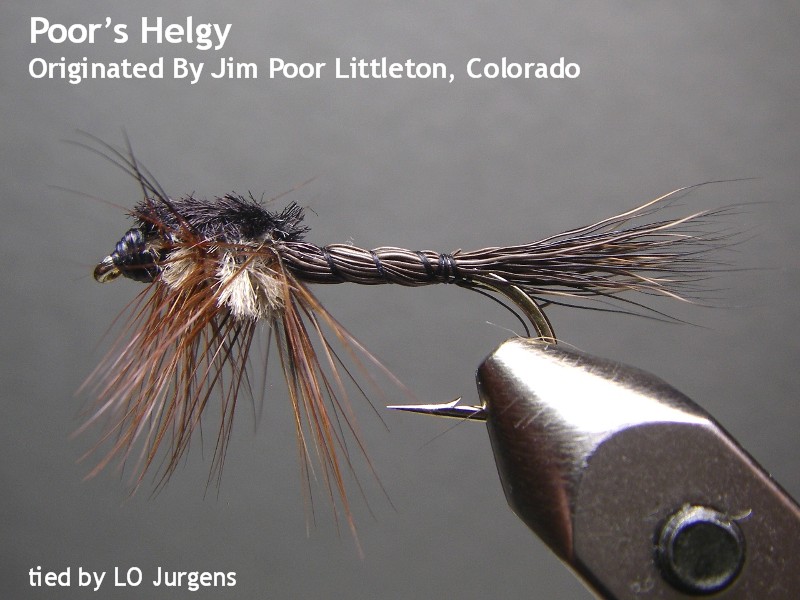
An Excellent pattern from the past originated by Jim Poor,who along with his wife Jane were original owners of Anglers All located in Littleton, Colorado. See url: http://www.anglersall.com/about for more info.

For tying instructions send me an email with
"Poor's Helgy tying instructions" on the subject line.
          ~ LoJ

Friday, March 02, 2012

Baetis Pattern


Pre-Emergent Baetis V2
By: Larry O Jurgens
Hook: TMC 2457, TMC 2487
Size: 16 ~ 22
Tying Thread: Dark Brown 8/0 UNI Thread
Head: Matte Chocolate 11/0 #02050 or 15/0 #32038 Mill Hill Glass Bead
Tail: Medium Pardo Coq De Leon  Whiting Tailing Barbules
Abdomen: Dark Brown UNI-Flexx or Spirit River Flex-Floss
Wing Buds: Natural Gray Canada Goose Biot(s)
 Thorax: Brown Hareline Quick Descent Dub


Send me an email for tying instructions.

Monday, February 27, 2012

A Pheasant Tale

About three weeks ago I was mulling over the fact that this past pheasant hunting season was such a total disaster (see Friday, January 20, 2012 I'm Baaaack! entry below) I made the decision to take advantage of a “pay for play” pheasant hunting enterprise. Since these enterprises hunting seasons are from September to March there was still time to rid myself and my dog Guy’s severe attack of cabin fever.

I contacted several of the “pay for play” enterprises before I made my decision of which one to experience. I wanted one that was close enough to make it a single day trip. As we (Guy and myself) waited for a semi decent weather forecast the tension was intolerable. It was so intense in the household that the BOSS told me to pick a day and get it done with, which I immediately did. The arrangements were made for the next day.

Since neither Guy nor I could sleep very well, like youngsters the anticipation was killing us, we arose earlier than needed and got out of the house and on our way. We made the drive to a small town near the intended destination and found a small restaurant that catered to the early rising locals and I partook in a huge and delicious breakfast and enjoyed some friendly conversation. It was pleasant surprise that the residents of this small burg harbored no ill will towards this big city personage.

Since my hunting buddy was relegated to the truck I bought a couple of pancakes and a generous piece of ham for him which he enjoyed immensely. After he finished his breakfast, had a large drink of water and a potty break we were on our way to nirvana.

Upon arriving at our destination we met our host at the clubhouse. After discussing the rules of engagement, services offered and the separation of me and my money I was ready to go.

He directed us to an area that was the most promising area to start. As I was getting Guy and my gear out he offered me this advice, “down in the old creek bed at the end of the mixed milo and corn field at around 7 to 7:30 there will be plenty of birds as the creek carries a small amount of spring water year around.”  This really charged me up. As you well know that pheasants, quail, etc. feed around daybreak and if there is water nearby they drink prior to laying up for the day.

Finally we are on our way and both Guy and I are filled with anticipation.  Just as we are leaving the yard the proprietor hollered out to me that in the aforementioned creek bed yesterday he spotted “THE BIG OL’ FAT WOOSTER CALLED WALPH”, the proprietor has a speech impediment  is speech challenged (have to be PC ya’ know) and waved us farewell.

We proceeded into the field and about 50 yards in Guy locks up on point. I approach and a rooster barrels out, I bring the gun up and proceed to miss. Guy runs about 100 feet in the hope that I didn’t miss, realizes I did miss and stops then continues hunting. About 5 minutes later he goes on point again I approach the bird flushes same result as before except Guy didn’t run as far and turned and gave me one of those disgusted looks that say “Look buster I’m doing my job so get on board and do yours.”

We continue on hunting, approximately 10 minutes later, the following occurs; Point, Approach, Flush except this time feathers fall but the bird doesn’t so off Guy goes. The bird and dog are heading for the next county. No amount of hollering, whistling will stop Guy from the chase. About 15 minutes later here he comes with a rooster in his mouth and still alive. He retrieves it to hand and I do my duty and dispatch it. We are both a little happier now.

We are now approaching the end of the field and the “creek bed” and I think to myself maybe, just maybe I might redeem myself in my dog’s eyes. About 20 feet from the end Guy locks up on point I in turn am just starting to hustle forward when Guy starts “flagging”, turns around and runs up and hides behind me.. I think to myself what the heck is going on. I ready myself thinking that there must be a coyote, bobcat or something else there. But seeing as I am toting a shotgun that holds four shots and I can in all likelihood handle the situation. I carefully approach the creek bed to see just what is there when lo and behold there is “WALPH” partaking in a drink of water with no fear of me or Guy.

“WALPH” is the biggest rooster pheasant I have ever seen or even heard of bar none!
I am glad that I have #6 shot shells loaded. I proceeded to pick up a dirt clod and threw it at him so he would flush as I really didn’t want to “Arkansas” him, but he just ignored it. I try again same result. One more time, same result. So I surmise that he has been hit before and can’t fly and I should finish the job.
I draw a bead on him and fire; he flinches but doesn’t go down for the count. I fire two more times with the same results but it looks like one more shot will do the trick. I pull out a shell loaded with #4 shot, draw a careful bead on his head and fire, down he goes for the count. I send Guy for the retrieve and he looks at me with a No Way Jose’ look and just stands there.

I hear the honking of a car horn and look around and see the proprietor bouncing around the field edge road at about 150 mph waving his fist out the driver’s door window. I am thinking what the heck is going on! With the dirt flying he slams to a stop about 10 feet from me, jumps out and is whoopin’ and a hollerin’ and congratulating me as for what I hadn’t figured out.  He finally settled down enough to explain that he was watching our progress with binoculars out of one of the second story windows and saw us dispatch “WALPH”.

So we picked the huge bird up, jumped into the truck and decided to head back to the club house for a hot cup of coffee. I forgot to mention that it was really, really cold and a tad breezy, most probably the reason for my previous misses.

Upon arriving at the clubhouse and imbibing a couple of “Irish” coffees I thought a picture of  “WALPH THE BIG OL’ FAT WOOSTER” was required. After drinking the coffee I figured that my and Guy’s hunting itch had been scratched.  Sure am glad that there are eight months for Guy to recover from this traumatizing experience.

I also surmised that those who read this account just might call it a “big Windy”, as they used to say.

You can see for yourself that this is NOT a big windy by perusing the picture below of the proprietor and “WALPH THE BIG OL’ FAT WOOSTER”.

Before I left the proprietor told me his name was Sam and his great, great, great grandfather was Samuel Clemens.


Saturday, January 28, 2012

Stonefly Patterns

In doing some research about stoneflies I stumbled onto an informative and interesting website, The Aquatic Insects of Gunnison County, Colorado at URL:  http://www.gunnisoninsects.org/index.html   
For tying instructions for the patterns email me. I have been tying these patterns for several years and they have been productive for me..


LoJ’s Gunny Willow Fly Nymph
By: Larry O Jurgens
Hook: Daiichi D1730 or Dai-Riki #700B
Size: 8 ~ 12
Thread: Tan 6/0 UNI-Thread
Tails & Antenna: 2# ~ 8# Monofilament
Colored Brown With A Brown Magic Marker
Rib: Brown Copper UTC Ultra Wire
Underbody: Lead or Lead Free Wire Sized To Match Hook Shank
Abdomen Material: Dark Tan Superfine Dubbing
Wingcase: Brown Thin Skin
Legs: Natural Whiting Brahma Hen Saddle
Thorax: Rusty Brown Ice Dub
Head: Gold Bead Sized Appropriately
Permanent Marker: Brown Sharpie
Optional: Super Glue and Water-based Head Cement


Note:
By using lead free wire for the underbody this pattern may be fished anywhere. For example Yellowstone National Park where the use of lead is prohibited.


LoJ’s Gunny Willow Fly
By: Larry O Jurgens
Hook: TMC 2312 or Dai-Riki #280
Size: 6~10
Thread: Fluorescent Orange Flat Waxed Nylon
Antenna & Tails: Speckled Tan Mini Centipede Legs
Optional Underbody: Monofilament Sized To Match The Hook Shank Diameter
Body: Orange and Brown 2mm Closed Cell foam
Underwing: Tan Midge Flash
Overwing: Mottled Web #522 MFC Wing Material
Legs: Orange & Black Barred Medium Centipede Legs
Optional: Sally Hansen Hard as Nails® “HaN” and Water-Based Head Cement


Friday, January 20, 2012

I'm Baaaack!

 Well, it’s been a long time since I have posted anything on the blog. I was busy with the annual “Bling Chicken Chase” which turned out to be a huge disaster this past season.
The area that my infamous Gang of Six hunts in Kansas was hit by a major drought. One of the farmers whose lands, appx 20+ sections owned or leased, we hunt told us that  his area of Southwest Kansas only recorded 1½” of moisture from 12/01/2009 until 11/01/2011.  If it wasn’t for pivot irrigation the area might have looked like it was the 1930’s Dust Bowl. Even the CRP areas were what you would call Apache grass, e.g., a patchy here, a patchy over there, etc., etc., etc.
As it was the infamous Gang of Six plus 4 dogs only produced 15 to 20 birds in effective shotgun range. Through our very effective(?) shootin’ we managed to put 4 “Bling Chickensin the dirt dust in two days. We then proceeded to drown our sorrows in other indulgences and decided to leave what few “Bling Chickens” were left for next years seed. But just like the Broncos “wait until next year”.

Now on to fishin' stuff!
The following has been a well producing pattern for me (in spring, summer & fall) and my winter fishing friends this winter and last. Give it a try as most fish haven't seen this pattern yet.
For the recipe and tying instructions send me an email with "Pattern Request"on the Subject line.

THANX for your support.

Friday, October 14, 2011

Baetis/BWO Pattern

Now that “Baetis Time” is upon us here is another Baetis/BWO pattern. 
Give this pattern a try (YOU can't have too many Baetis/BWO patterns) it has served me well. 
When tied in the appropriate sizes it is an excellent Baetis/BWO as well as a General Purpose Mayfly pattern.
Click on the picture for a larger view.
Remember you can highlight and copy both the large and small pictures.

Iron Bridge Olive Mayfly V1 (aka Iron Bridge Baetis V1)
By: Larry Jurgens
Hook: Dai-Riki #280, TMC 100/101/501
Size: 16 ~ 22
Thread: Olive Dun 8/0 UNI Thread
Tail: Medium Pardo Whiting Farms Coq de Leon Tailing Barbules
Wing: Medium Dun Float-Vis
Abdomen: #9 Baetis Nature’s Spirit Turkey Biot Quill “Vane”, See Notes
Thorax: Blue Wing Olive Superfine Dubbing
Hackle: Olive Dyed Silver Badger or Olive Dyed Grizzly Whiting Saddle, See Notes
Head: Tying Thread
Notes:
The “vane” barbule is from the opposite side of the biot on a primary wing feather or a barbule from a secondary wing feather.
This pattern can be tied with or without the “standing rib”. The fish don’t seem to mind one way or the other!
 The hackle is one size under-sized e.g., size 18 hook equals size 20 hackle.
Send me an email for tying instructions

Saturday, September 03, 2011

One of my "Old" 1960s patterns


This is the modern version of the original “Cutthroat Candy” pattern that I developed in the 1960’s for fishing the creeks and lakes in the Derby Flattops area. The United States Congress designated this area the “Flat Tops Wilderness” (map) in 1975 and it now has a total of 235,214 acres. All of this wilderness is located in Colorado and is managed by the Forest Service.This pattern is my #1 pattern when fishing the forks of Derby Creek along with several others that I fished. It is also effective on the more accessible creeks feeding into Stillwater Reservoir and the Bear River outlet clear down to Sweetwater Reservoir (aka Yampa Reservoir). My “Original Recipe” used the following materials; Mustad 94840 hook, Black tying thread, Barred Lemon Wood Duck tail, Red four strand rayon floss for the abdomen, Muskrat dubbing for the thorax, Grizzly hackle and Yellow Bucktail for the post indicator (for visibility) and the Trude type wing.Even though I call the pattern “Cutthroat Candy” it also works great for Rainbows, Browns, and Brookies!  ~ Larry O Jurgens


The Original Cutthroat Candy
Originated and Tied By: Larry O Jurgens
Hook: TMC 100 (Originally Tied On A Mustad 94840)
Size: 12 ~ 16
Tying Thread: Light Cahill 6/0 Danville Fly Master
Tail: Barred Lemon Wood Duck
Abdomen: Red Danville’s Flat Waxed Nylon
Indicator/Wing: Bright Yellow Polypropylene
Thorax: Light Cahill Superfine Dubbing
Hackle: Grizzly

Saturday, July 30, 2011

The Venerable Cooper Bug

Peacock Cooper Bug
By: Jack Cooper
Tied By: Larry O Jurgens
Hook: Hook Is Tyers Choice
Size: 10 ~ 20
Thread: Tan or Black UTC 70
Tail, Shellback and Head: Elk Body Hair, Bleached or Natural
Body: Peacock Herls
Notes:
This is a very old pattern and has been called devil bug, doodle bug etc., etc., depending on the location.

The following is excerpted from The Perfect 10: New England Natives by William G. Tapply at

Downeaster Jack Cooper invented this simple deer-hair bug back in the 1930s to catch the brook trout that gobbled caddisflies off the surface of his local ponds. The fly worked so well that Cooper applied for a patent. He was denied on the grounds that his bug was too similar to Orley Tuttle’s Devil Bug. Bob Elliot, for decades the official spokesman for Maine’s angling tourism and an expert on eastern brook trout, gave a handful of Cooper’s bugs to my father (Tap Tapply ~ loj). Dad gave ‘em a try and declared the Cooper Bug his favorite all-round searching fly. We fished them dead-drifted upstream, both to rising trout and to likely pockets. We cast them down and across and twitched ‘em back. We caught a lot of brookies both ways from the streams we floated in Dad’s canoe.
 Gary Borger’s Devil Bug is tied differently and is a more complicated tie. To view his tying instructions got to URL; http://www.garyborger.com/flies-and-fly-tying/devil-bug/
I have tied, and tried Gary Borger’s Devil Bug and it works well and it floats a little higher and longer before becoming water saturated.
Send me an email for tying instructions.

Monday, June 27, 2011

A Small Productive Streamer Pattern


This streamer pattern has been very productive for me. I fish it on small streams as you would fish a “BIG” streamer on a larger river. When I fish the Li’l Trigger Sucker on large rivers it fishes best (for me anyway) by working the edges and back-eddies. I fish the Li’l Trigger Sucker with a floating line and to represent an injured minnow trying to survive.


Li’l Trigger Sucker
By: Larry O Jurgens
Hook: TMC 9395, TMC 5262 or TMC 5263
Size: 8 ~ 10
Thread: Olive UTC 70
Body: Root Beer Flat Diamond Braid
Wing: Sculpin Olive Pine Squirrel Strip
Collar: Micro Olive Pine Squirrel Strip or Sculpin Olive Pine Squirrel Hair Dubbing Loop
Trigger: Red 1/64 Holographic Mylar Motion (Simulates A Bleeding Gill Blood Stream)
Head: Olive or Black 5/32” Cone Head
Optional: Super Glue


Note:
I tie this pattern several different ways; see optional Steps 4, 13, 15 & 16.
The optional steps I use the most are Steps 4 & 13 using a Micro Sculpin Olive Pine Squirrel Strip.
At Optional Step 13 use a dubbing loop of Olive Pine Squirrel Hair or a Micro Sculpin Olive Pine Squirrel Strip and make two to three wraps for the collar.

Tying Instructions
    1.  Slide the cone head on to the hook shank.
    2.  Wrap a threadbase so that the cone head is tight on the hook shank.
    3.  Cut off the thread.
    4.  Optional: Apply super glue to the threadbase.
    5.  Slide the cone over the threadbase to behind the hook eye.
    6.  Restart the thread and wrap a thread base to above the hook barb.
    7.  Tie in the strip above the hook barb leaving enough to reach the cone head.
    8.  Tie in the body material in front of the strip.
    9.  Move the thread to behind the cone head.
 10.  Wrap the body material to behind the cone head. Tie in and cut off excess.
 11.  Pull the strip forward and tie in behind the cone.
 12.  Tie in 1~2 trigger strands on each side of the hook shank.
 13.  Optional Step: See Note. Tie in and cut off excess.
 14.  Whip finish behind the cone head with a minimum number of wraps.
 15.  Optional; Apply water-based head cement to the thread wraps.
 16.  Optional; Cover the thread wraps with dubbing from the Olive Pine Squirrel strip.
 17.  Cut the tail to equal the hook shank length.
 18.  Cut the trigger Mylar to length of your choice. 

Sunday, May 01, 2011

Four Caddis Patterns

These patterns have been tested over the last two years by myself and others in various rivers on the Western Slope and Front Range in Colorado. They have also been fished in California and Idaho with good results.
I tie these in a variety of colors and they have all had some success. The Tan, Brown and Chartreuse colors have produced the best results.
Send me an email if you would like the recipes and tying instructions.
Tie some up and let me know how they worked for you!


Sunday, April 17, 2011

Hogans’s Red-Headed Stepchild Pattern

The Real “Hogans’s Red-Headed Stepchild”
Visit Hogan Brown's website at URL;http://www.hgbflyfishing.com/hgbflyfishing/Trout_Nymphs.html


Hogan's Red Headed Stepchild
By: Hogan Brown of Chico, CA
Source: Hogan Brown’s Website 
Hook: TMC 3761, Daiichi D1560, Dai-Riki #060
Size: 12 ~ 18
Head: Red Silver Lined Glass Bead
Thread: Rusty Brown 6/0
Tail: Pheasant Tail Barbules
Abdomen: Tying Thread
Rib: Red Ultra Wire
Flashback: Pearl or Opal Tinsel
Thorax: Peacock Herl
Legs: Red Krystal Flash 

Tuesday, March 01, 2011

North Park Skeeter/Midge


North Park Skeeter/Midge 
(Montana Midge by us "Old-Timers")
By: Larry O Jurgens
Hook: TMC 100 or TMC 101
Size: 12 ~ 18
Thread: Iron Gray UNI-Thread
Abdomen: Natural Canada Goose Biot or Vane
Wing: White or Light Dun Float-Vis
Thorax: Adams Gray Super Fine Dubbing
Hackle: Natural Grizzly
Head: Tying Thread


Notes:
When fishing in North Park especially the Delaney Buttes and Lake John areas there are two very pesky critters that are constantly gathering in gigantic clouds around you. These two critters are the Mosquito that feasts on you and the “Montana Midge” (this is what we called them in bygone days) that you feasted on as they were constantly being breathed in as you are trying to wave them away. As all North Park fishermen well know both species of critters are impervious to any and all repellents.
In my younger days the most effective repellent was smoking a very bad smelling cigar. One of the most effective was the rum soaked “Mississippi Crooks” which, if I remember correctly a box of five sold for 25 cents and were about three to four inches long and about one half inch in diameter. And they were NASTY little things. The price was the same as a full pack of Camels, Lucky Strike etc. cigarettes in those bygone times.
Smoking a pipe with strong tobacco like “Prince Albert and Sir Walter Raleigh” was also an effective repellent.
A “Prince Albert” tobacco can was used by my “Dad” for his fly box. 

Tying Instructions
1.    Start the thread behind the hook eye.
2.    Wrap a smooth threadbase to above the hook barb.
3.    Tie in the biot and wrap a smooth threadbase forward to the 1/3 hook shank point.
4.    Wrap the biot to the 1/3 hook shank point.
5.    A “standing or no standing” rib is tyers choice.
6.    Tie in and cut off excess.
7.    Tie in the wing at the 1/3 hook shank point.
8.    Tie in the hackle at the wing tie in point.
9.    Dub the thorax to one eye length behind hook eye.
10. Wrap the hackle forward to one hook eye length behind the hook eye.
11. Tie in the hackle and cut off excess.
Note: Trim a “V” notch in the hackle on the bottom of the fly to allow the fly to ride low on the water’s surface.
Trim the hackle flat on the bottom if you want the fly to ride flush on the surface.

Sunday, January 30, 2011

Midge Pattern


Black Biot Midge
By: Larry O Jurgens
Hook: TMC 102Y
Size: 17 ~ 21
Thread: Olive Dun 8/0 UNI Thread
Abdomen: Black Goose/Turkey Vane (See Notes)
Shellback: Black Foam
Wing: White Float-Vis
Thorax: Black Superfine Dubbing
Hackle: Black
Head: Tying Thread

Thursday, December 16, 2010

An Old Time Colorado Fly Pattern

Jonnie Come Lately (Cream Caddis Larvae)
Source: Terry Hellekson Book,
Popular Fly Patterns, Published 1977
Originator: Joe Nelson, Colorado Springs, Colorado
Hook: Mustad 3906/3906B
Size: 14 ~ 18
Thread: Black
Abdomen: Pale Yellow Wool Yarn or Rabbit Dubbing
Rib: Gold Wire
Thorax: Dubbed Muskrat Fur
Head: Tying Thread
Optional Head Cement: Hard as Hull or Black Hard Head
Send me an email for tying instructions.

Tuesday, November 30, 2010

Blinged Chickens


The blinged chicken hunting has been excellent this year in the wilds of Kansas. So far the weather has been fairly cooperative. As usual there was a brisk wind that sucked up what little moisture there was, really could have used some snow tho’.
Opening weekend was really good but as usual all the dumber ones were dispatched fairly early. As the weekend progressed the smarter ones became wilder as the hours passed.
Our “gang” consisted of six guns and four dogs and we dispatched a good many of those colorful creatures. It is a good thing that we don’t have to hunt the public areas only as there were some very large “war parties” tramping around. Every group that you talked to had a good hunt and a good harvest. The motel where we stay sets up a bird cleaning station complete with running water for the patrons every year. This year the dumpster seemed to contain a good deal more of the leavins’ than the past couple of years.
This past Thanksgiving weekend we also had some excellent hunting and dog work. The weekend was cut short due to a family catastrophe which I will not discuss now.
Our dogs had many points and retrieves which made the trips even more enjoyable. Due to the dog work and the accuracy of some of the shooters we managed to put a good many birds in the freezer.
Due to my macular degeneration in my left (master) eye I am in the process of trying to learn to shoot right-handed after shooting left-handed for sixty one years. It is very challenging and my results are far from successful. After several points  my dog Guy pointed a rooster that I managed to put in the dirt (for my first right-handed kill) and he made a perfect to hand retrieve for me all-in-all that made my trip(s). Per my poor math skills I figger that that bird cost me approximately $484 and change, again I re-iterate that it was well worth it.
I will be making at least one more trip to the wilds of Kansas around Christmas time and again, hopefully another in January. I am planning to bring the cost per bird down dramatically!! Wish me luck.
At the very least my supply of pheasant tails has increased dramatically!